
The Science of Ergonomic Office Chairs: What Research Actually Shows About Seating and Productivity
22 Sept 2026 • 7 mins read
"Ergonomic" is one of the most overused words in furniture marketing — slapped on any chair with a headrest, regardless of whether it's backed by anything. This guide skips the marketing language and goes straight to what peer-reviewed ergonomics research actually shows about seating, posture, and productivity, then turns those findings into a practical buying checklist.
Part 1: The Real Problem Isn't Sitting — It's Staying Still
For decades, ergonomics research chased a single question: what is the one "correct" sitting posture? Over the last two decades, that focus has shifted. Reviews of the ergonomics literature now describe the shift as moving away from identifying a single ideal posture and toward a more dynamic view of sitting — one that keeps the body in motion even while seated, rather than locking it into one "correct" position.
This matters because it changes what a chair is supposed to do. A chair isn't succeeding if it forces one rigid, "proper" posture. It's succeeding if it supports movement — recline, tilt, dynamic lumbar response — through the day.
What happens when posture stays static for too long
Research on prolonged static sitting links it to several measurable effects: increased spinal load, disrupted trunk posture, rising contact pressure and discomfort, and vascular strain in the lower body. The ANSI/HFES 100 standard, a widely used reference in office ergonomics, recognizes four working postures — reclined sitting, upright sitting, declined sitting, and standing — and research comparing them has found that the risk isn't inherent to any one posture; it's staying locked into any single posture for extended, uninterrupted periods.
Practical implication: a chair with a fixed backrest angle and no recline mechanism works against how the body is meant to move through a workday, regardless of how supportive it looks in a showroom.
Part 2: What the Research Says About Sitting Time and Productivity
Here's a genuinely counterintuitive finding. A large cross-sectional study of more than 2,000 full-time office employees examined the relationship between sitting time and self-reported productivity. Total sitting time on its own was not significantly associated with productivity. What was associated with productivity were two other factors: job satisfaction (a positive link) and fatigue (a negative link). Employees who sat the most also reported the lowest job satisfaction and the highest fatigue — and it was that combination, not the hours in the chair itself, that tracked with lower output.
This reframes the entire ergonomic-chair conversation. A chair's job isn't to reduce how long someone sits — it's to reduce the fatigue and discomfort that come from unsupported sitting, because fatigue is what actually erodes performance.
Part 3: Sit-Stand Desks — What the Evidence Actually Supports
Sit-stand and height-adjustable desks have become a common ergonomic upgrade, and the research on them is more nuanced than the marketing suggests.
- Workplace studies consistently show sit-stand access reduces total sitting time and improves short-term musculoskeletal comfort.
- A posture-tracking study conducted in a real office setting found that when given the option, employees voluntarily switched to standing for roughly 45-50 minutes a day on average, concentrated in the afternoon between 2:30 and 4:00 PM — right around the point where post-lunch fatigue typically sets in.
- Reviews examining sit-stand desks and productivity specifically describe the evidence as still developing — comfort and discomfort-reduction benefits are well established, but a direct causal link to measurable output gains is an active area of ongoing research rather than a settled conclusion.
Practical implication: don't buy sit-stand desks expecting a guaranteed productivity spike you can point to in a KPI dashboard. Buy them because the discomfort-reduction and fatigue benefits are well supported — and fatigue, as shown in Part 2, is what actually predicts lower output.
Part 4: How Poor Seating Creates Measurable Injury Risk
Beyond comfort, poor seating has a documented injury pathway. Ergonomic risk-assessment tools like RULA and REBA — standard methods used across industries to score musculoskeletal risk from posture — have been applied in industrial and office-adjacent settings to identify high-risk seated setups. Intervention studies using these tools have documented measurable improvements in posture-related issues, including forward head position and rounded shoulders, after ergonomic corrections were made.
The underlying mechanics are the same in an office chair: a seat with no lumbar adjustment, fixed armrests that don't match desk height, or a backrest that doesn't support the natural spinal curve creates the same category of postural risk identified in these formal industrial assessments — just accumulating more slowly, over months instead of shift-length exposures.
Part 5: A Research-Backed Buying Checklist
Based on the findings above, here's what actually matters when choosing an ergonomic chair — separated from what's just aesthetic.
Non-negotiable, evidence-backed features
- Adjustable lumbar support that follows the natural inward curve of the lower spine (the "neutral" position identified in postural research)
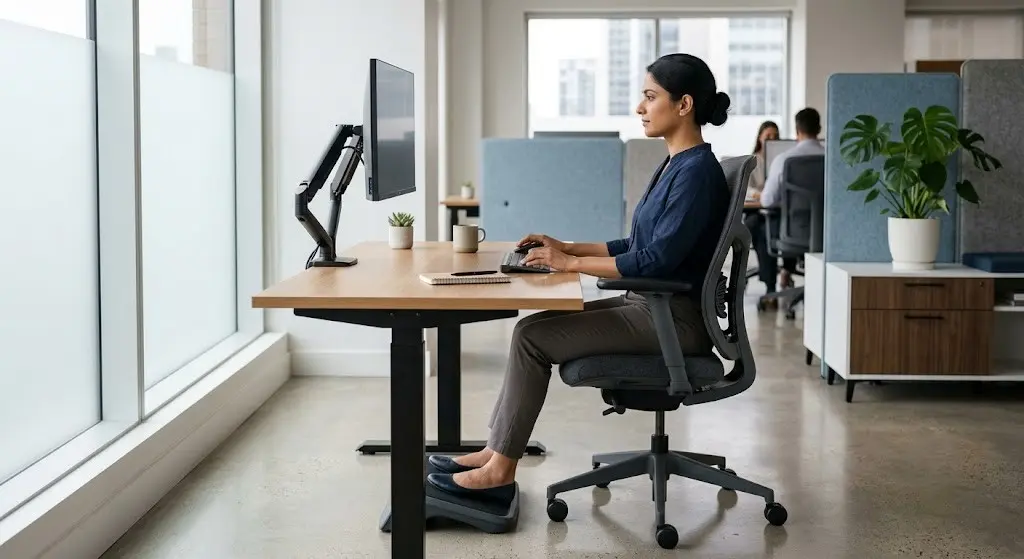
- Independent seat height adjustment, so the chair can match desk height rather than forcing wrists or knees into an unnatural angle
- A dynamic tilt or recline mechanism — not a fixed-angle backrest — so the chair supports movement rather than locking one posture
- Adjustable armrests, to keep shoulders relaxed and wrists aligned with the keyboard
- Breathable seat and back material (mesh or ventilated cushioning), which reduces pressure buildup during long, uninterrupted sitting stretches — particularly relevant in warmer Indian office environments
Nice-to-have, not evidence-critical
- Fabric color and pattern
- Frame finish (chrome vs. matte black, etc.)
- Headrest — helpful for reclining postures, but not essential for typical upright desk work
What to ask before buying
- Does the lumbar support adjust, or is it fixed in one position?
- Can the seat height and armrests be independently adjusted for different body types on the same team?
- Does the backrest recline or tilt dynamically, or is it locked at one angle?
- What's the warranty on the gas lift and frame — these are the components most likely to fail under daily multi-year use?
- Has the chair been used in a real office environment for an extended trial period, not just tested in a showroom for five minutes?
Part 6: Why This Is a Cost Decision, Not Just a Comfort One
Fatigue and discomfort, as shown in Part 2, are directly linked to self-reported productivity — which means poor seating isn't just an employee-comfort issue, it's a quiet cost center. Sick days linked to musculoskeletal discomfort, higher turnover in roles with long desk hours, and the replacement cost of chairs that fail early because they were bought on price alone all add up faster than the price difference between a basic chair and a properly specified ergonomic one.
Final Thought
The research doesn't support marketing claims like "this chair boosts productivity by X%." What it does support, clearly and repeatedly, is that unsupported, static, fatigue-inducing seating is a measurable drag on comfort, health, and — through fatigue and satisfaction — output. A chair built around adjustable lumbar support, dynamic movement, and independent height and armrest controls is solving a real, documented problem, not just checking a marketing box.
At Natraj Furniture, our seating range is built around these exact principles — engineered for Indian workplaces, not just styled to look "ergonomic" on a shelf.
Explore our seating range: View Office Chairs
Sources referenced
- ScienceDirect — "Active workstations: A literature review on workplace sitting"
- ScienceDirect — "The impact of sit-stand office workstations on worker discomfort and productivity: A review"
- BMC Public Health — "Quantifying the impacts of posture changes on office worker productivity"
- NCBI/PMC — "Workplace Sedentary Behavior and Productivity: A Cross-Sectional Study" (Kansas government employee survey, n=2,068)
- NCBI/PMC — "Ergonomic interventions for work in a sitting position: an integrative review"
- PMC — "The Effectiveness of Ergonomic Intervention in Work-Related Postures and Upper Crossed Syndrome of Metal Industry Workers"
- ANSI/HFES 100-2007, "Human Factors Engineering of Computer Workstations" (as referenced in cited reviews)